
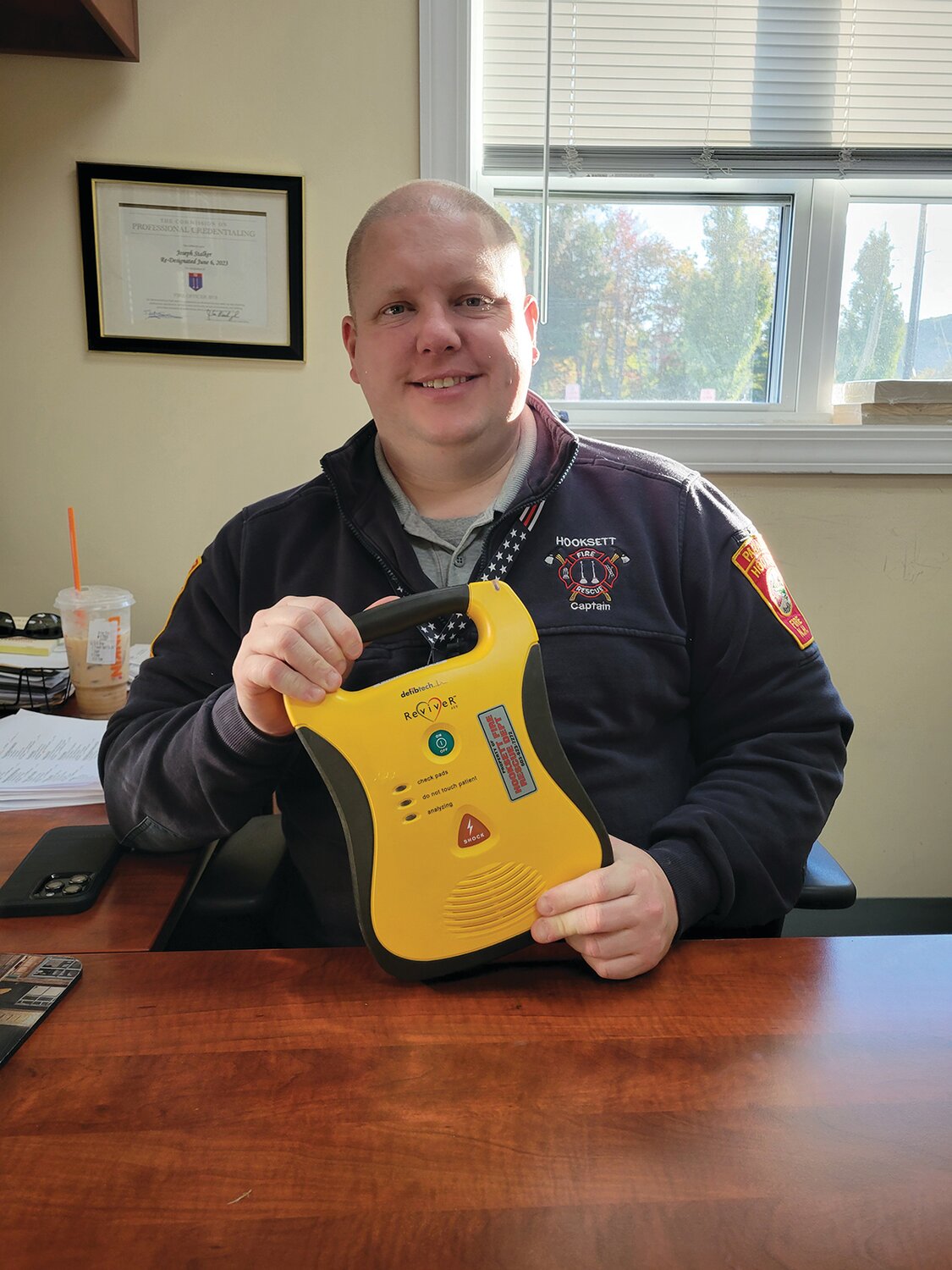
HOOKSETT – According to the American Heart Association, there are 356,000 out-of-hospital sudden cardiac arrests in the United States each year – roughly 1,000 per day – and nearly 90 percent of them are fatal. The Hooksett Fire and Rescue Department recently launched a new automated external defibrillator (AED) loaner program that aims to improve those numbers.
“We are constantly looking at injury and illness prevention,” said Joseph Stalker, captain of Hooksett’s EMS Department. “If we could prevent injury and illness instead of just responding, we would be so much better at what we do.”
Enter the department’s new AED loaner program, which Stalker calls “a no-brainer to offer to the community.”
The department received a grant earlier this year to replace some of their AEDs, and they repurposed two of them for this program.
Any Hooksett resident (age 18+) or business is eligible to borrow one these devices, free of charge, for up to two weeks for use during any kind of event, from backyard weddings and family reunions to sporting events and company outings. It doesn’t matter if you are expecting seven people at your event or 70; wherever people gather, an easily accessible AED can be a lifesaving tool.
Cardiac arrest can happen to anyone, at any time, so it is important to know the signs. People who experience sudden cardiac arrest collapse, stop breathing, and no longer have a pulse. They are completely unresponsive; they do not move, speak, blink, or react even if you shake them.
At this point, said Stalker, “there is only a small window (of time)] before irreversible damage is done to the body.” During this small window following a cardiac arrest, three events must happen quickly – and in the right order – to maximize a person’s chance of survival. Together, they comprise the first three links in what is known as the “Chain of Survival.”
In any cardiac emergency, the first thing you should do is call 911. Second, begin what is known as hands-only CPR. This form of CPR is as effective as traditional mouth-to-mouth CPR in the first few minutes after cardiac arrest, and it does not require certification or extensive training.
Simply push hard and fast in the center of the chest, two inches deep, at a rate of 100 to 120 compressions per minute until paramedics arrive.
It can be helpful to perform the compressions to the beat of a familiar song, said Brenda Vitali, marketing communications director for the Maine and New Hampshire branches of the American Heart Association. Examples include “Stayin’ Alive” by the Bee Gees, “Crazy in Love” by Beyonce, and “Walk the Line” by Johnny Cash. She recommends Googling songs with 100 to 120 beats per minute to find one you like and are likely to remember.
“Hands-only CPR enables the oxygenated blood still in )the patient’s) system to continue to circulate while you wait for EMS to arrive,” said Vitali. “If you start those compressions while EMS is en route, you lower the likelihood that the patient will suffer irreparable damage to the brain or heart.”
Bystanders can be lifesavers
The third link in the Chain of Survival is an easily accessible, readily available AED, and this is the purpose of Hooksett’s loaner program. An AED delivers an electric shock to the heart to restore a normal rhythm after a person has experienced cardiac arrest.
Stalker said people should not be intimidated to borrow the AEDs. They are automated, which means they do all the hard work for you. Hooksett’s loaner AEDs are lightweight, portable, and designed for anyone to use. They have just two buttons: On/off and Shock. Each device comes with two pads, which are placed on the victim’s chest. Voice prompts talk the user through this process, step by step.
Additionally, Hooksett Fire and Rescue will train each borrower in hands-only CPR and the basic use of the AED, which takes about 20 to 30 minutes. (If the borrower is already trained in CPR, they can borrow the AED with minimal paperwork.)
“These devices are smart,” said Stalker. “They immediately start analyzing the heart, and they know when to defibrillate.”
“An AED will never shock anyone that doesn’t need to be shocked,” said Mary Newman, president of the Sudden Cardiac Arrest Foundation, a national nonprofit organization that aims to educate people on the important role bystanders can play. She called Hooksett’s AED loaner program “a great community service. With programs like this, so many lives could be saved.”
Although there are Good Samaritan laws in all 50 states to protect bystanders from liability, “only 40 percent of people who suffer a sudden cardiac arrest get help,” said Vitali. “We want more than 40 percent of bystanders to feel capable and confident in their ability to step in and help because bystanders can be lifesavers.”
In September, bystanders saved the life of someone right here in Hooksett, said Stalker. The victim suffered a sudden cardiac arrest in a building with a public, easily accessible AED. Bystanders called 911, began CPR on the victim, and used the AED to restore a normal heart rhythm. By the time police and EMS responded, the victim had been revived, an outcome Stalker hopes to see more often.
“Even if this program saves one life, it has done its job,” he says. “Out-of-hospital cardiac arrests have a 10 percent survival rate, but when you have bystanders, CPR, and public access AEDs, the survival rate jumps to 40 percent or higher. How can you say no to a program that could help us achieve those rates?”
To borrow one of Hooksett’s loaner AEDs, call 603-623-7272, Ext. 5; email Capt. Stalker at jstalker@hooksettfire.org; or stop by the Safety Center any day between 8:00 a.m. and 5:00 p.m.


